
I Struggled With Substack Notes For Months. Here’s What FINALLY Worked
Sometimes, consistency is all about simplicity


Substack officially declared itself social media.
Which means the game changed.
It’s not going to replace Medium anytime soon.
Long-form articles still matter. But if you want new subscribers discovering your work, you need Notes.
The problem? Posting Notes consistently when you’re a long-form writer is a gentle nightmare.
Posting Notes daily is a pain in the booty
When I first started with Notes, I did what most people do.
I’d sit down every single day, stare at a blank screen, and ask myself: “What should I post today?”
I’d look at my feed, and would try to come up with some punchy ideas.
But that actually killed the joy of writing.
And the thing that’s supposed to help you grow becomes the thing you avoid.
Most people quit right here. They convince themselves Notes “don’t work” or “aren’t worth it.”
But the problem isn’t Notes. It’s the approach.
My anti-Notes writing approach
Your brain is like an old gasoline engine.
It needs some time to get to warm up to function at its best.
That’s why you should never just create one Note and close your laptop. You should batch multiple Notes. Ideally, a full week worth of Notes in one siting.
I batch all my Notes when I’m writing my long-form articles. Especially during the editing process because that’s when I chop away all the fluff.
The rest of the week? I’m free to focus on other parts of my business like launching new products. Or better yet, actually live my life.
Stop treating each Note like a separate creative session. Batch them.
Most of your Notes will suck
Here’s the thing nobody tells you about Notes: most of them won’t work.
76% of my notes actually don’t drive any subscribers.
And that’s fine.
But you need to know which ones DO work so you can do more of that.
There is a hidden function that you can use in Substag that actually shows you the analytics for each note you publish.
It looks like this:
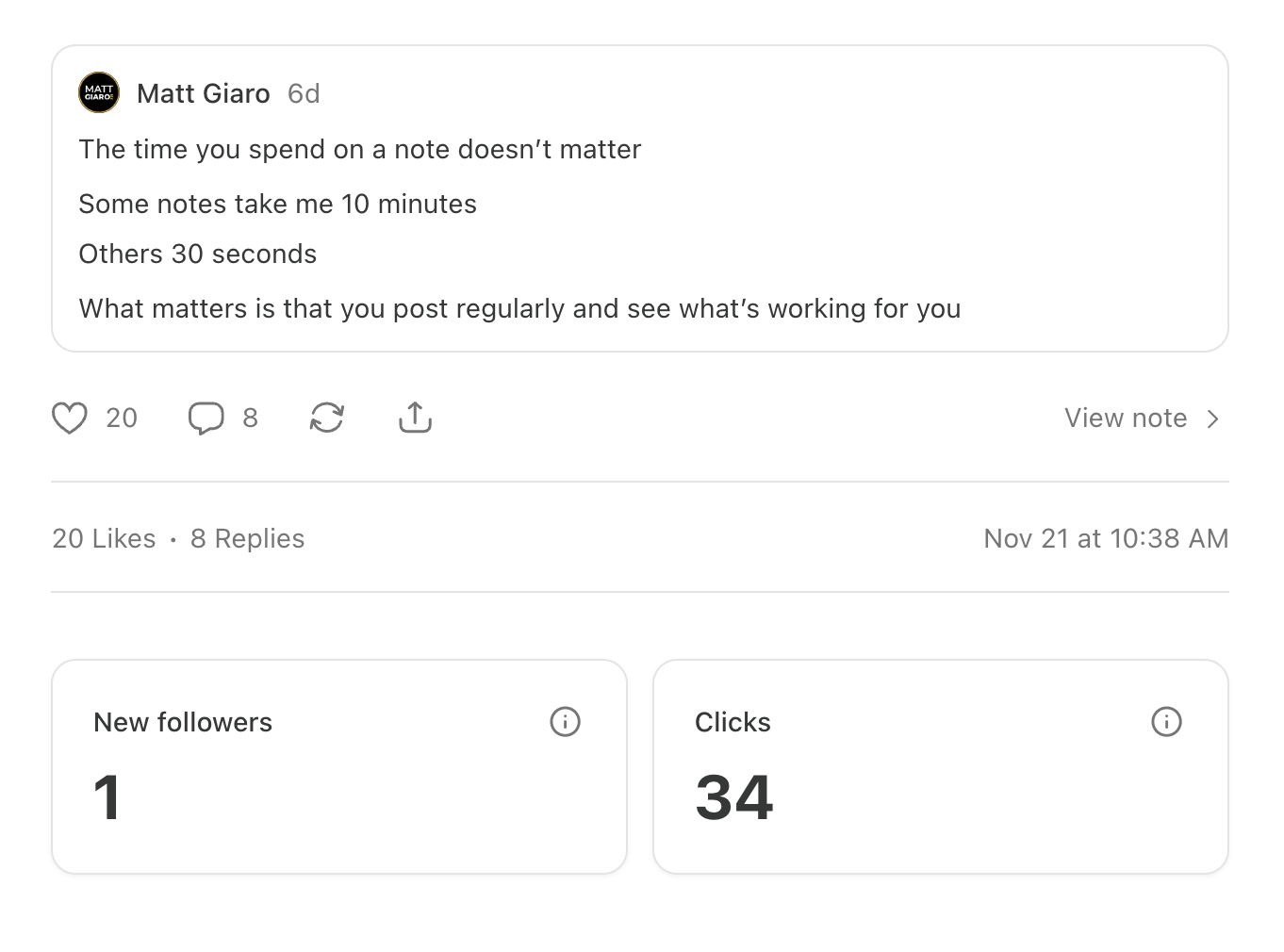
I check my analytics to see which Notes actually drive the most subscribers.
Not likes. Not comments. Not restacks. Subscribers.
Because that’s what matters.
You could do this manually. But the Substack interface is confusing. If you’re publishing 30 Notes, it means going through that same tedious process 30 times.
That’ll suck 30 minutes out of your life. And for me, it it’s not a wise investment of my time.
So I use a tool that sorts my Notes by subscribers in one dashboard. I can see exactly which ideas resonated and brought people in.
Once you know what works, you can stop guessing. And start repurposing.
Rehashing winning ideas (sorry)
Okay, most of you purist writers will actually roll your eyes.
But if you’ve been into content creation for at least 3 years, you know the importance of repurposing what’s already working.
When I first started creating content, I thought it was about coming up with new ideas for every piece.
But that’s only partially true.
Yes, you want new ideas. But more importantly, you want to get more mileage out of the ideas you already had and that resonated with your audience.
Which means less work, more results.
Once an idea resonates, there’s no issue re-spinning it to get even more subscribers.
Heck you could even use Ai to do this.
Think of it like Apple. They have a few best-selling products. So what do they do every year? They add a new spin to something that’s already working.
I do the same with Notes.
I take a Note that drove subscribers and create 5–10 variations of the same core idea:
Different angles.
Different wording.
Same insight.
Most people don’t even notice. And honestly, I didn’t notice it myself until I started being conscious about it.
It’s like a magic trick: you only see how it works once you know it.
Writing Notes was actually the easy part
Batching notes is simple if you do what I shared earlier.
Now came another friction point: Posting these notes.
See, I’m not a person who actually enjoys scrolling through Substack and the short form feed.
So I basically ended up with a lot of notes in my drafts that I didn’t even publish. Because Substack has no scheduling feature.
First, I had to manually dig through Substack analytics to find winning Notes. That meant juggling 35+ tabs and creating ugly spreadsheets.
Then I’d take those Notes to AI and copy-paste prompts to generate variations.
And once I had the Notes ready? I still had to manually remind myself to post them throughout the day.
What should’ve been a simple task became a complex process that demanded time, effort, and willpower.
I like simple. And I like leverage.
All this was anti-leverage and dumb monkey work.
The tool that saved my streak
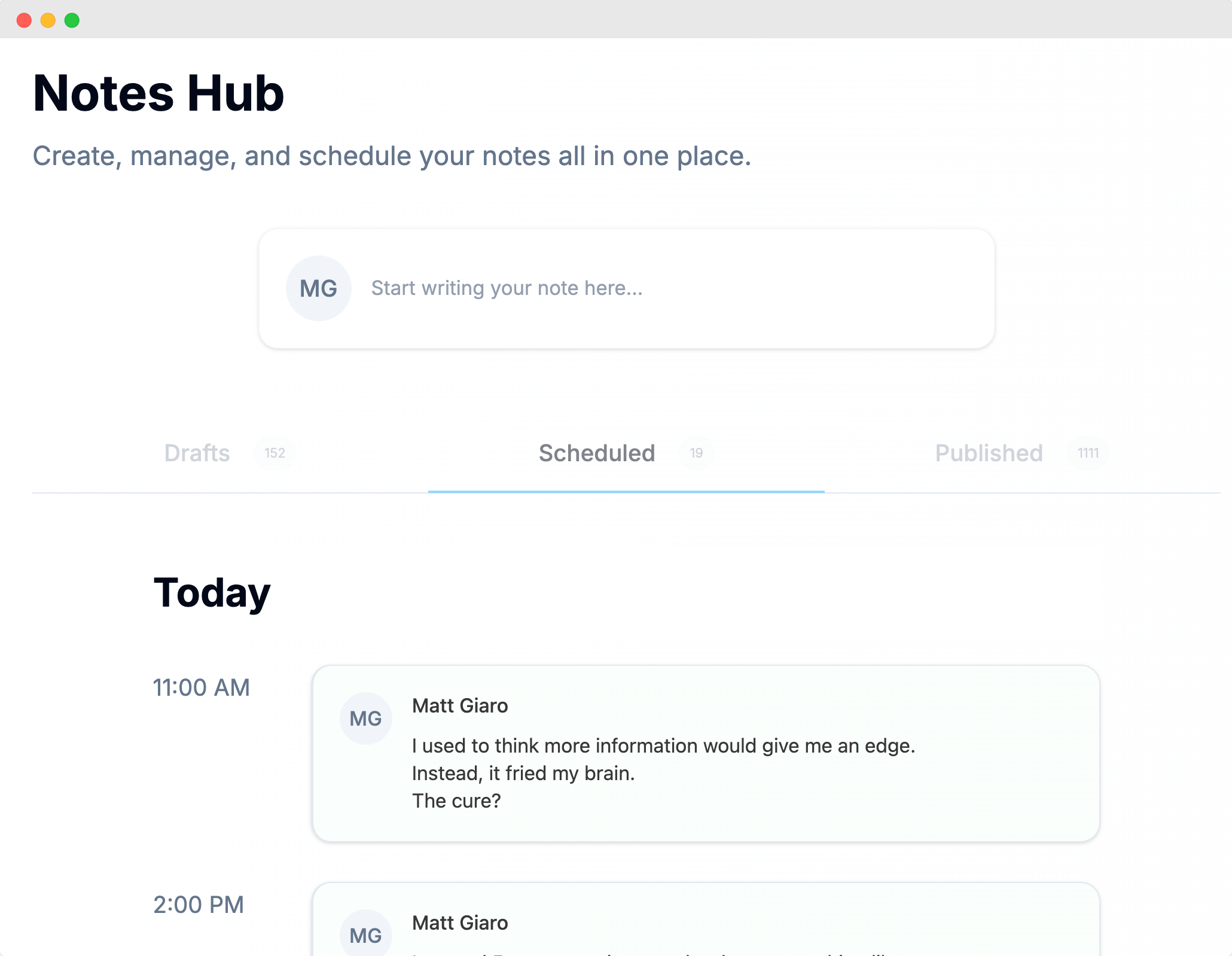
Stacksweller does all of this in a few clicks.
Finds my best-performing Notes
Generates variations of these notes (to drive more subs)
Schedules them to post at different times throughout the day (and night.)
What used to suck out hours of my life each week, now takes me 10 minutes.
Posting Notes should be easy
In August, I got 419 subscribers from Substack.
In September, 463.
All this by posting Notes sporadically, forcing myself, and relying on willpower.
In October, I started using Stacksweller as it was in closed beta. I posted only 5 long-form articles. But 61 Notes. The result? 792 new subs.
That’s a 71% increase in one month.
The difference wasn’t working harder. It simply removing all this useless friction with an app that costs less than 4 Starbucks lattes.
Good insight! Thanks Mr. Giaro
Are there any patterns with winning notes?