


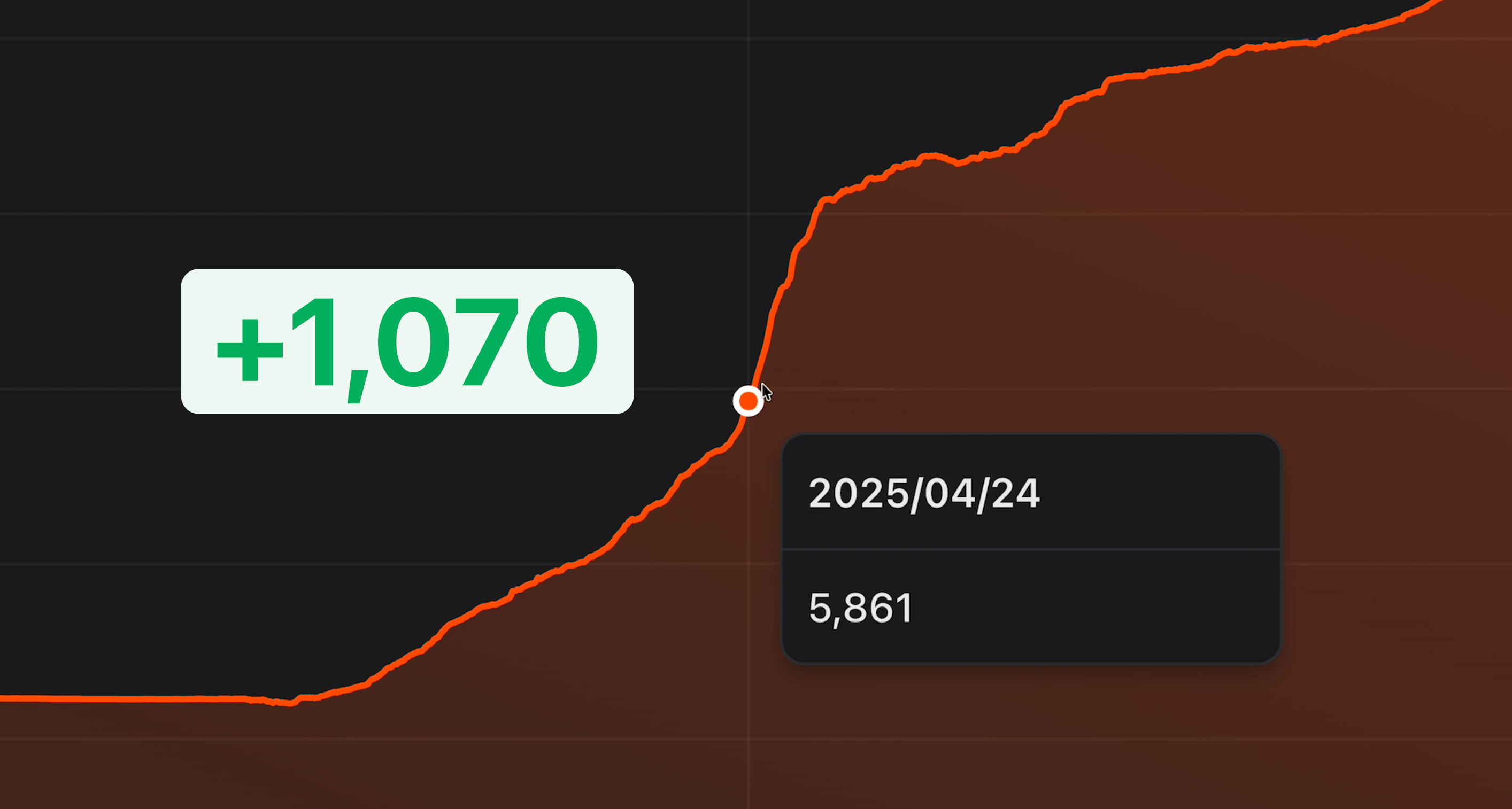
I added 1,070 subscribers to my Substack in 30 days by writing one article a day.
If you want to publish consistently, you have to stop making decisions while you write. Because if one article eats your whole weekend, then you’re not a slow writer.
You’re just doing the steps it requires to publish a great article in the wrong order.
Writing one article used to take me two weeks. Two weeks of opening a doc, writing a few sentences, deleting them, and closing the laptop.
I didn’t fix that by getting better at writing.
But by stopping freestyling my article writing process.
All you need is to follow the 6 steps I’ll share with you today.
So this is going to be extremely useful if you want to build a body of work, become a thought leader, and attract more newsletter subscribers.
1. The One Sentence
Before anything else, say the whole article in one line.
Not a topic. A sentence.
“Posting daily on Substack” is a topic. It’s a subject with no claim inside it. You could write fifty different articles under it and none of them would be about anything.
“You can post daily on Substack by following these simple steps” is a sentence. It makes a claim. And a claim tells you exactly what the rest of the article has to prove.
Topics don’t write articles. Sentences do.
If you can’t compress your idea into one sentence, you don’t have an idea yet. You have a feeling.
And the simplest way to nail it is by using what I call the hinge:
Every sentence swings on one word in the middle. There are only two.
You can {achieve outcome or remove pain} without ⎯⎯⎯⎯.
You can {achieve outcome or remove pain} by ⎯⎯⎯⎯.
Now here’s the interesting part: you can use the same outcome (or problem) and still come up with interesting ideas:
You can grow a newsletter without posting on social media.
You can grow a newsletter by answering one reader question a week.
Everything downstream comes out of this line.
Get it wrong and you won’t notice for three hours — you’ll be 800 words in, rereading the same paragraph, wondering why it won’t land.
2. The Headline
Having a good idea is not enough to make people click.
Instead, you need a way to package your idea into a headline that earns the click.
The best way is to keep a swipe file with titles that made you click or are popular. Doesn’t need to be in the same niche.
I have a short swipe file you can grab that’ll give you plenty of good headline ideas.
I’d suggest you write 10. And then narrow it down to 1.
This feels like overkill until you realize the headline is the only thing standing between your article and nobody reading it. I used to write the whole post first, then spend two hours hunting for a headline. Backwards.
Now I write it first, because a strong headline tells me exactly what the article needs to prove.
3. The Points
99% of people who I coach mess this up.
It’s the whole reason writing an article consistently feels so hard.
They skip this step, start typing, and hope it goes somewhere. It never does.
So if you don’t want to waste your Sunday afternoons editing a Word document, pay close attention to this.
Break your one sentence into 3 to 5 smaller ideas that support it.
As an example, this article is about writing articles fast. That’s the main idea. Now, each point (or section if you prefer) is a separate idea that supports the main idea.
This is your outline.
Each point becomes a section. That’s it. You’re not writing an article anymore.
Now, you’re filling in blanks. More on that in just a few.
4. The Hook
Okay, now you have a title, a main idea, and 3-5 sections.
Before starting to write these, we need to nail one thing: your introduction. Hook. Or opening. However you wanna call it.
The opening gets its own slot because it has its own job:
The headline earns the click. The opening needs to validate that clicking was the right choice. Otherwise, they’ll bounce to another suggested piece.
There are a gazillion ways of writing intros.
The best I found are:
A personal story
A big problem
A rant
I give you specific examples of each one of these in a free cheat sheet you can download at this link.
It has to be something that makes the reader think “this looks interesting.”
That’s a different sentence than the rest of your draft, and it deserves its own attention before you barrel into the body.
5. The Coffee-Shop Draft
Now write the body, the text that goes underneath each one of your bullet points (step 3 - you remember?)
The point is to make a point.
Write it the way you’d explain it to a friend over coffee, not the way you’d present it to a board. Each section already has a job from your outline, so you’re not hunting for what to say next, you’re just saying it.
Pro tip: Use voice dictation.
I try to keep each one of my sections around 150 words. (150*3 = 450 words which is enough for an essay)
Faster to write, faster to edit.
6. The Final-Pass Edit
This is the part that kills most people. (And don’t ask me how I know!)
They sit on a finished draft for days because some voice in their head keeps asking “what if this is the one that makes people unsubscribe.” That voice isn’t your reader. That’s your inner critic.
If your outline was solid, there’s nothing structural left to fix, just repetition to cut and vague lines to sharpen.
That’s a 10-15 minute job, not a weekend project.
Work is like water. It takes the shape of whatever container you give it. Give it a weekend and it will take the whole weekend. Give it an hour and... you get the point.
Here’s how I do it: I give myself ONE editing pass. And then I hit publish.
That’s all folks
It took me 300+ posts to come up with and refine this super-simple framework.
Now you have it in your hands and can start posting.
One last thing before I go: you’re taking this article writing thing way too seriously.
Your first 10-20 pieces will be bad. Publish them. Every time you hit publish you become 1% better. And watch your subscriber number grow.
This was incredibly helpful, Matt! It made me realize my approach to writing articles was way too disorganized. I really like the simple framework you suggested, and I’m planning to give it a try. Thank you!😊
Thanks for sharing your thoughts; will definitely use some of the suggestions.