
How To Grow With Notes (When You Hate Writing Notes)
This tactic helped me grow by 792 new subscribers per month


I hate short-form content.
There. I said it.
I’m a long-form writer. I think in paragraphs, not in one-liners.
But Substack’s discovery engine for long-form articles is garbage.
You can write the best damn article of your life, but most of your subs won’t see it.
So what are you left with? Posting more Notes.
I resisted Notes for months.
But since I’ve combined Notes with articles and commenting, Substack has become my number one email subscriber source.
Here’s how to thrive with Notes (even when you hate them.)
Notes aren’t your real creative work
Stop thinking of Notes as “content creation.”
They’re not.
Your long-form articles are your real body of work. That’s where you:
develop ideas
build authority
and actually think.
That’s where you create depth and show people what you know.
Notes are just billboards on the highway pointing people back to the real stuff. Notes are the necessary evil that makes your preferred format actually get read.
You still get to write long. You still get to think deep. You still get to do the work you actually enjoy.
Notes just help more people actually see it.
Never start with Notes. Never.
Start with your weekly long-form article.
This is your anchor content. The 700–1,500 word piece where you actually think and develop ideas.
I spend about 30–60 minutes writing my weekly article. Some weeks it’s faster. Some weeks it takes longer because I’m wrestling with an idea that doesn’t want to cooperate.
But this is always the starting point.
When you write long-form first, you’re never staring at a blank screen trying to think of something clever for a Note. The thinking is already done. The ideas already exist.
You’re just repurposing into Notes later.
But the trick is to structure your article intentionally. Don’t write one giant blob of text where everything blends together.
Instead, write in sections.
For example, if you’re writing about email marketing, you might have:
Section 1: Why most people’s subject lines suck
Section 2: The formula I use for subject lines
Section 3: A personal story about a subject line that bombed
Section 4: How to test subject lines without overthinking it
Each of those sections is a complete thought. Each one can stand alone. Each one becomes a Note later.
This is the raw material for everything else.
There are three formulas I use all the time to easily outline any piece. I’ve pulled them into a cheat sheet you can download on this link (it’s free.)
Use an AI Note-Extractor
Some people feel weird about using AI for this. They think it’s cheating or lazy.
It’s not:
YOU wrote the original ideas.
YOU developed the arguments.
YOU added your stories and examples.
AI is just a pair of scissors helping you cut these into smaller pieces for distribution.
That’s all Notes are anyway. Smaller pieces of your real work.
Take your finished article and feed it to AI.
I’ve tried ChatGPT, but Claude’s output is just better for this kind of work.
Give it a simple prompt: “Read this article and identify the 4–5 distinct ideas or arguments. Then rewrite each one as a standalone Note between 20–150 words.”
That’s it.
The AI pulls out your
Voice
Ideas
Examples
Stories
It’s just reformatting what you already wrote. One article can become 4–5 Notes in a few minutes.
Now, here’s the thing: You might need to fine-tune the prompt a bit. Maybe feed Claude a few examples of Notes you’ve written manually so it understands your style better.
Maybe it’s stripping off too much context.
Maybe you need to tell it “keep it conversational” or “don’t use corporate buzzwords” or whatever your specific quirks are.
But you only do this work once.
And then? That prompt works forever.
You’ve built yourself a little extraction machine that spits out Notes in your voice every single time you feed it an article.
Also understand that the quality of the AI output is going to depend on how good (or bad) your initial article is.
That’s why you should never write any article without this free cheat sheet.
Record more ideas on the go
You’ve got 4-5 Notes from your weekly article. Maybe a bit more.
But if you’re posting 3–5 Notes per day, you need more than that. You need around 21–35 Notes per week.
So where do the rest come from?
Voice memos.
I get my best ideas when I’m NOT sitting at a computer trying to be creative.
Like when:
Driving
Walking
Doing random housework
Your brain works differently when you’re moving.
When you’re sitting at a desk staring at a blank screen, your brain tenses up.
But when you’re moving? Ideas just flow. You’re not forcing them. They come naturally.
So I use a voice dictation app called Letterly:
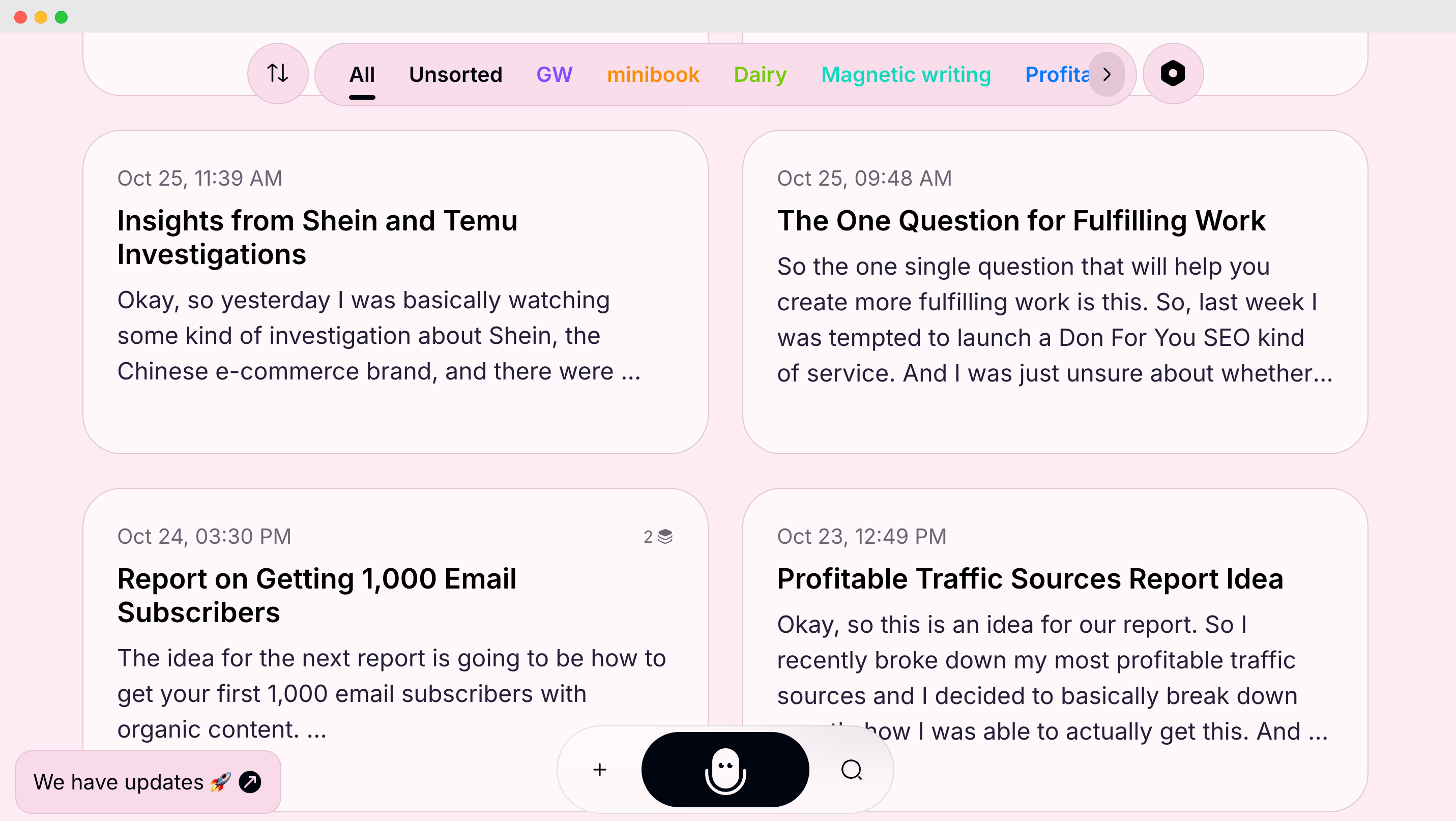
I simply record my thoughts out loud.
I then use the AI writing feature in Letterly to make this punchier.
Stick to 3 simple Note formats
Templates are the easiest way to turn any idea into a publishable piece of content.
Notes are no different.
I analyzed hundreds of Notes over the past weeks, and here’s what works:
Personal stories.
Educational pieces.
Motivational content.
That’s it.
Personal stories get crazy engagement. Anything personal your audience cares about. Could be about your business, your family, your failures, your wins. Doesn’t matter. People connect with personal.
Just make sure it actually ties back to your target market.
Just posting about your granny’s birthday is not going to get you quality subscribers, even though it might get you a lot of engagement.
Educational pieces demonstrate your expertise. You’re solving a problem. You’re teaching something. You’re sharing what you know in a way that makes someone’s life easier.
Motivational content gives people a boost. Most people are drowning in negativity online. They want something uplifting. Something that makes them feel like they can do it too.
Here’s the trick: You can take one idea and create three different Notes by changing the angle.
Let’s say you have the idea “drink water before meals to eat less.”
Personal story: “I lost 12 pounds after back surgery without trying. Wasn’t exercising—couldn’t. Wasn’t dieting—was miserable enough already. I was just drinking water before meals to wash down painkillers. Took me three weeks to realize what was happening.”
Educational piece: “People who drink 16oz of water 10 minutes before meals eat 75–90 fewer calories per meal. That’s 15 pounds a year. No diet. No app. Just water and a timer.”
Motivational piece: “Every diet you’ve tried has failed. Not because you’re weak. Because they’re complicated. Drink a big glass of water before you eat. Do it for a month. Then tell me nothing changed.”
Same idea. Three angles. Three pieces of content.
This framework prevents you from overthinking what to write. You’re not sitting there wondering “what should this Note be about?” You already know. You’re just deciding which angle to use.
And honestly? Most of the time, the angle picks itself based on what you’re feeling when you write it.
Schedule everything in one sitting
Writing first Note drafts is just one part of the equation.
The other part is getting these Notes out on the right days and at the right times.
Your audience isn’t all reading Substack at 10 am Eastern Time.
Some check it at lunch.
Some check it in the morning.
Some scroll through Notes at night before bed.
If you only post once at the same time every day, you’re missing huge chunks of your potential audience.
I schedule 3–5 Notes per day spread across different times:
Morning.
Afternoon.
Evening.
That way, no matter when someone opens Substack, there’s a decent chance they’ll see something from me.
Substack doesn’t have a Notes scheduling feature, so you need a tool to handle this for you. I use StackSweller.
I like to sit down once per week, schedule all my Notes, then I’m done with it:
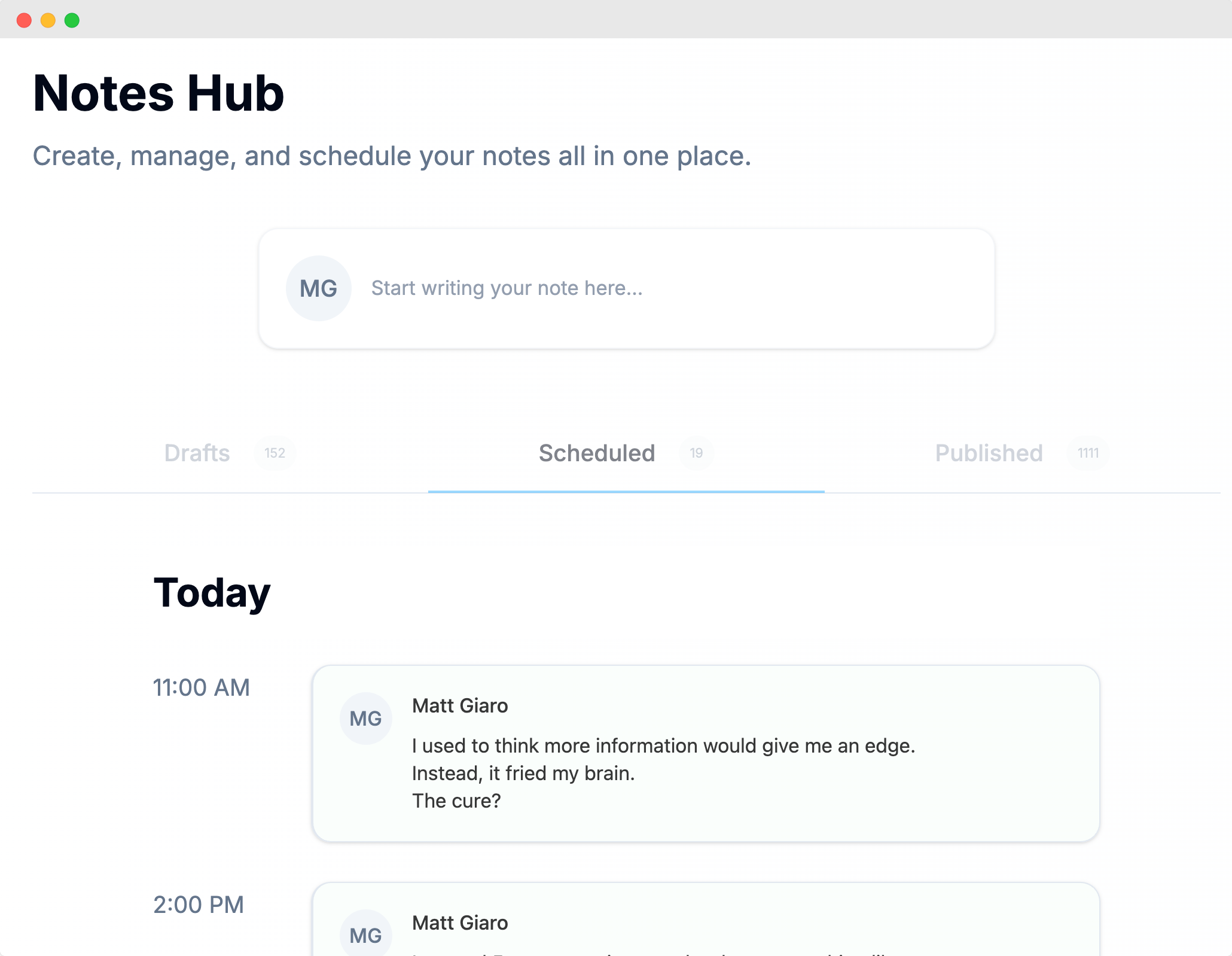
The work happens once. The distribution happens automatically throughout the day, all week long.
I’m not checking Substack every two hours. I’m not posting manually. I’m not deciding “what should I say today?”
This is the difference between being a content creator and being a content slave.
Let’s finish here
Notes don’t have to be torture.
They don’t require you to become someone you’re not. They don’t demand you sacrifice your long-form thinking for punchy one-liners.
You just need a system that respects how you actually want to work.
Write long.
Extract short.
Schedule everything.
That’s it.
I went from hating Notes to having them help me get more subs and eyeballs. You can do the same thing.
Now go build the system once so you never have to think about it again.
Great breakdown of your simple process Matt
Letterly and Stacksweller both look interesting
Hey Matt,
This is extremely well thought out, and I really appreciate the functionality of your approach to Notes.
I love short-form writing — it’s why I spent so much time on Twitter before finally seeing the light and moving over to Substack.
As I’m still experimenting with Notes, here are a few experiences and perspectives I’ve had so far:
Notes are not the creative work
Interestingly, I actually feel they are. Notes are a great mechanism for being supportive of:
- Other creators
- Other readers
- My own and others’ Notes
- My own and others’ Posts
They feel less like “output” and more like connective tissue.
Using an AI Note extractor
I’m currently building a Notes OS, and one aspect I haven’t explored yet is AI. What I’m building is focused on consistency — for myself and others — and creating a bank of “ready” Notes that come from a central repository of ideas. At the moment, it’s entirely manual and intentionally not using AI.
Recording more ideas on the go
I really like what you’ve done here. My own approach looks like this:
Inputs for ideas: rest, sleep, massages, showers, and sitting in quiet spaces — these are often where ideas actually form.
Idea generators:
Internal: thoughts, lived experience, previous Notes and Posts, articles written elsewhere — essentially my existing body of work.
External: books, podcasts, videos, and conversations with people.
Sticking to 3 simple Note formats
Absolutely love this. I’m currently working with around 12 different category-based Note formats, which will eventually support several dozen templates.
While scheduling Notes will work well for many people, I still see real value in a slow, steady, manual publishing process, it preserves the “feel” of the Notes stream.
Scheduling everything in one sitting
Schedule when you can. Schedule in one sitting. Schedule when you’ve built up enough to fill the backorder bank.
I love the fact that we can have so many different approaches, all working toward the same outcome.